

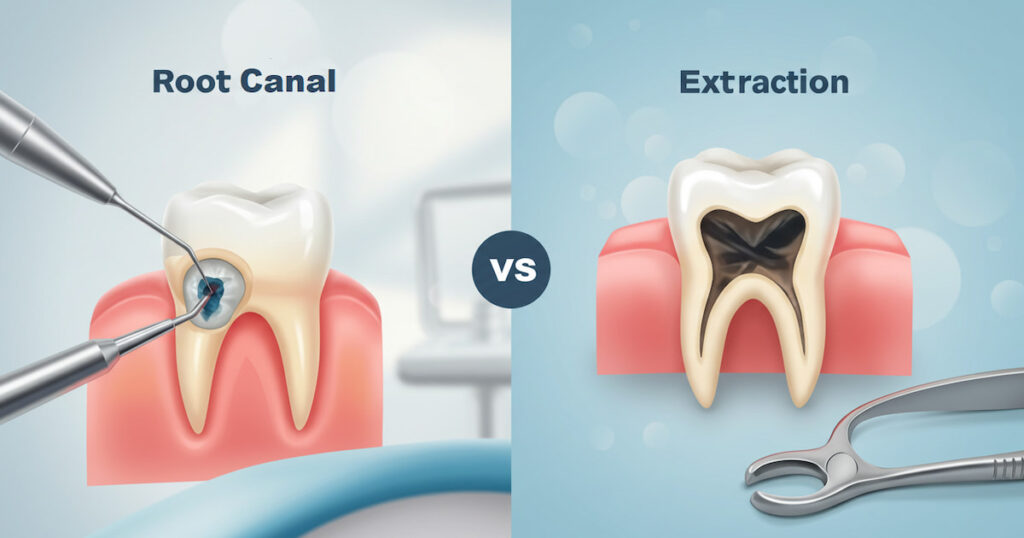
If a damaged or infected tooth can still be predictably restored, root canal treatment is often considered before extraction because it allows you to keep the natural tooth. Extraction may be recommended when the tooth cannot be restored reliably or when other clinical factors make saving it impractical.
There is no single answer that applies to every root canal vs extraction decision. The condition of the tooth, remaining tooth structure, gum and bone support, the location of any crack or fracture, previous treatment, and the restoration needed afterward can all affect the recommendation. A dental examination and appropriate X-rays are usually needed before deciding between root canal treatment and tooth extraction.
Root Canal vs Extraction at a Glance
| Factor | Root Canal | Tooth Extraction |
| Main goal | Remove inflamed or infected pulp while keeping the natural tooth | Remove the tooth completely |
| When it may be considered | The tooth is affected internally but can still be restored and supported | The tooth cannot be predictably restored or saving it is not clinically appropriate |
| Natural tooth | Preserved | Removed |
| After treatment | A filling, crown, or another restoration may be needed | The extraction site must heal; replacement may be recommended depending on the tooth and treatment plan |
| Recovery | Temporary tenderness or biting sensitivity can occur | Socket healing may involve bleeding, swelling, soreness, and temporary diet or activity changes |
| Future treatment | The tooth can sometimes require retreatment, restoration repair, or extraction later | An implant, bridge, denture, or another plan may be considered for the missing tooth |
| Cost considerations | Depends on the tooth, treatment complexity, and final restoration | Depends on the type of extraction and whether replacement or additional procedures are needed |
What Is a Root Canal?
Root canal treatment, also called endodontic treatment, is used when the pulp inside a tooth becomes inflamed, infected, injured, or no longer healthy. The pulp is the soft tissue within the tooth that contains nerves and blood vessels.
During treatment, the dentist accesses the inside of the tooth, removes the affected pulp, cleans and shapes the root canal system, and fills and seals the space. The tooth then needs an appropriate restoration so it can continue to function.
The restoration is not identical for every tooth. Depending on the tooth and how much healthy structure remains, treatment may involve a filling, a dental crown, or another restorative approach.
The main advantage is straightforward: if treatment is appropriate and successful, you keep the natural tooth instead of creating a missing-tooth space.

What Is a Tooth Extraction?
A tooth extraction removes the tooth from its socket. It may be considered when a tooth is too damaged to restore predictably, has an unfavourable crack or fracture, has inadequate support, or when removal is part of another appropriate dental treatment plan.
Some extractions are relatively straightforward, while others require a surgical approach. The complexity depends on factors such as the tooth’s position, root shape, surrounding bone, and the reason for removal.
Removing a permanent tooth also creates a new question: what should happen to the space? For many functional permanent teeth, replacement may be recommended to restore chewing function and reduce unwanted changes in the surrounding teeth. Depending on the situation, options can include a dental implant, bridge, or removable prosthesis. Not every extraction requires tooth replacement, so this decision should be part of the treatment plan rather than assumed in advance.
Root Canal vs Extraction: Pain and Recovery
Patients frequently search for which treatment hurts more, but pain is not a reliable way to choose between them. Local anaesthetic is commonly used for both procedures, and individual experiences vary according to the condition of the tooth and the complexity of treatment.
Recovery After a Root Canal
A root-canal-treated tooth can feel tender or sensitive to pressure for several days, particularly if there was significant inflammation before treatment. Symptoms should generally move in the direction of improvement.
Severe or increasing pain, visible swelling, an uneven bite, or symptoms that return after improving should be assessed. Our guide to root canal treatment side effects explains which symptoms can occur during recovery and when to contact a dentist.
Recovery After an Extraction
Extraction recovery involves healing of the socket where the tooth was removed. Bleeding, swelling, tenderness, and jaw soreness can occur after oral surgery. The recovery experience depends on whether the extraction was simple or surgical, the location of the tooth, and the patient’s individual healing factors.
If you want more detail about recovery after removal, see our guide to tooth extraction healing time. Follow the specific aftercare instructions provided by your dentist or oral surgeon rather than relying on a fixed timeline that may not apply to your procedure.

Root Canal vs Extraction Cost: Look Beyond the Procedure Fee
A simple extraction may have a lower initial fee than root canal treatment, but comparing only the first procedure can give an incomplete picture. Root canal treatment usually also requires a final restoration, while extraction may be followed by tooth replacement or other procedures.
| Cost Factor | Root Canal | Extraction |
| Procedure complexity | Varies by tooth, canal anatomy, diagnosis, and treatment complexity | Varies between simple and surgical extractions |
| Restoration | A filling, crown, or another restoration may be required | No restoration is placed on the removed tooth |
| Replacement | The natural tooth remains in place | An implant, bridge, denture, or another approach may be considered |
| Additional treatment | Retreatment or additional restoration may occasionally be needed | Bone grafting or other procedures may be recommended in some treatment plans |
The most useful comparison is therefore the complete treatment plan, not a generic online price. Ask what is included in each option, whether additional appointments or restorations are expected, and what portion may be covered by your dental plan.
Which Option Is Better for Long-Term Tooth Function?
When a natural tooth can be predictably saved and restored, keeping it avoids creating a missing-tooth space and preserves the tooth’s own root, periodontal support, and role in the bite.
That does not mean root canal treatment is automatically better in every case. A tooth with inadequate remaining structure, an unfavourable fracture, severe loss of supporting tissues, or another poor-prognosis condition may not be a good candidate for preservation.
After an extraction, changes can occur around the missing-tooth site, and adjacent teeth may shift when a space is left unmanaged. A dentist can explain whether replacement is recommended and which option fits the rest of your bite and oral health.
Potential Risks and Complications
Neither procedure comes with a guarantee. The relevant question is which treatment offers a reasonable prognosis for the specific tooth and patient.
Possible Problems After Root Canal Treatment
A treated tooth may occasionally fail to heal as expected or develop a new problem later. Possible reasons include complex canal anatomy, reinfection, a leaking restoration, new decay, or a crack. Depending on the diagnosis, retreatment, endodontic surgery, restoration, or extraction may be considered.
Possible Problems After Tooth Extraction
Extraction has its own healing risks, including bleeding, infection, dry socket, delayed healing, and discomfort around the surgical site. The likelihood and type of complication depend partly on the tooth, procedure, medical history, smoking or vaping, and how the site heals.
Increasing pain, worsening swelling, fever, persistent drainage, or another concern after an extraction should be assessed rather than self-diagnosed. Our guide to tooth extraction infection covers warning signs in more detail.
Root Canal vs Extraction: Pros and Cons
| Option | Potential Advantages | Potential Limitations |
| Root Canal | Preserves the natural tooth; avoids creating a missing-tooth space; can restore function when the tooth is suitable for treatment | Requires a restorable tooth; a filling or crown may be needed; retreatment or extraction can occasionally become necessary later |
| Extraction | Removes a tooth that cannot be predictably restored; may be appropriate when prognosis for saving the tooth is poor | Creates an extraction site and potentially a missing-tooth space; healing is required; replacement may add treatment, time, and cost |
When Might a Root Canal Be Considered?
A dentist may discuss root canal treatment when the pulp is irreversibly inflamed, infected, or damaged but the rest of the tooth has a reasonable prognosis for restoration.
- There is enough healthy tooth structure to restore the tooth appropriately.
- The tooth has adequate support from the surrounding gums and bone.
- Any crack or fracture does not make the tooth predictably non-restorable.
- The tooth has a useful role in the bite and preserving it fits the overall treatment plan.
- The patient understands the required restoration and follow-up care.
When Might Extraction Be the Better Option?
Extraction may be recommended when keeping the tooth is unlikely to provide a predictable or useful result. The decision is based on the whole tooth and supporting tissues, not simply on the presence of infection.
- The tooth has insufficient remaining structure for a predictable restoration.
- A crack or fracture makes the tooth non-restorable.
- The tooth has inadequate periodontal support.
- Previous treatment has failed and further tooth-saving treatment is not considered appropriate.
- Removing the tooth is part of a broader dental or orthodontic treatment plan.
These are treatment-planning considerations, not rules that can be applied without an examination. In borderline cases, your dentist may also discuss whether referral or another opinion would help before removing a permanent tooth.

How Do You Decide Between a Root Canal and Pulling the Tooth?
If both options are being discussed, ask your dentist to explain the prognosis of the tooth rather than simply asking which procedure is faster. Useful questions include whether the tooth is restorable, what restoration will be needed after a root canal, whether retreatment is a realistic option, and what would happen to the space if the tooth were extracted.
You should also understand the complete treatment plan for each option. An extraction may look simpler when viewed as a single appointment, but replacing a missing tooth can involve additional treatment. A root canal preserves the tooth, but the tooth still needs to be restored and monitored.
The appropriate choice depends on diagnosis, prognosis, your overall oral health, and your informed preferences after the available options have been explained.
FAQ
-
Is it better to get a root canal or pull the tooth?
If the tooth can be predictably restored, preserving the natural tooth with root canal treatment is often considered before extraction. Extraction may be more appropriate when the tooth cannot be restored reliably or has a poor prognosis. A dental examination and X-rays are needed to make that decision.
-
Which is more painful: a root canal or tooth extraction?
Local anaesthetic is commonly used for both procedures, so the treatment itself should be managed for comfort. Recovery differs: a root canal can leave temporary tenderness, while an extraction requires healing of the tooth socket and may involve swelling, bleeding, or jaw soreness. Individual experiences vary.
-
Is a root canal more expensive than an extraction?
A simple extraction may have a lower initial procedure fee, but that is not the complete comparison. Root canal treatment may require a filling or crown, while extraction may be followed by an implant, bridge, denture, bone graft, or other treatment. Ask for the complete treatment cost for each option.
-
When is extraction better than a root canal?
Extraction may be recommended when the tooth cannot be predictably restored, has an unfavourable fracture, lacks adequate support, or when further tooth-saving treatment is not considered appropriate. The presence of infection alone does not determine which option is better.
-
Do I need a dental implant after tooth extraction?
Not necessarily. An implant is one way to replace a missing tooth, but bridges, dentures, or another treatment plan may also be appropriate. Some extracted teeth do not need replacement. Your dentist can explain whether the space should be restored in your particular case.
-
Can a root canal tooth still need to be extracted later?
Yes. Some root-canal-treated teeth can develop new decay, fractures, reinfection, restoration problems, or other conditions that make additional treatment necessary. Depending on the diagnosis, retreatment, endodontic surgery, restoration, or extraction may be considered.
Need Help Deciding Between Root Canal and Extraction?
Smile Avenue Dentistry can examine the tooth, review the relevant dental imaging, and explain which options may be appropriate for your situation. Our clinic is located at 325 Sheppard Ave E in North York.