
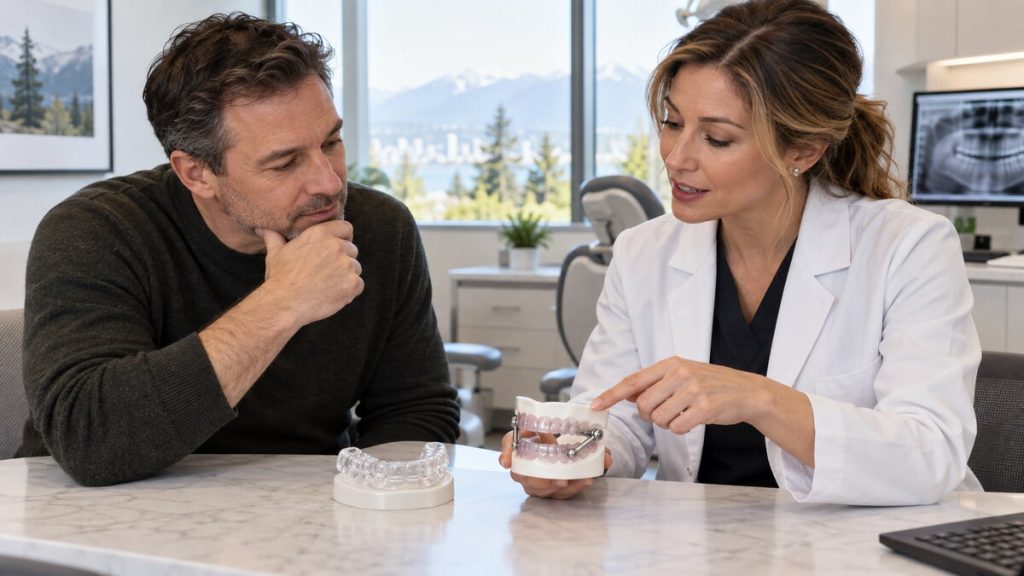
Night guard vs snore guard: although these dental appliances may look similar, they are designed for different problems. A night guard is primarily used to protect the teeth and jaw from the effects of clenching or grinding. A snore guard usually refers to an oral appliance designed to move the lower jaw forward to help keep the airway more open during sleep.
They are not interchangeable.
If you grind your teeth, snore loudly, or wake up with jaw discomfort, the first step is identifying the actual problem rather than choosing an appliance based on its appearance.
Quick distinction: a night guard is generally designed to protect teeth from grinding and clenching, while a snoring oral appliance is designed to reposition the lower jaw to help maintain the airway during sleep. Suspected sleep apnea requires appropriate medical assessment rather than self-treatment with a mouth guard.
Night Guard vs Snore Guard at a Glance
| Feature | Night Guard | Snore Guard / Oral Appliance |
|---|---|---|
| Main purpose | Protect teeth from grinding or clenching | Help manage snoring or certain sleep-related breathing problems |
| Common issue | Bruxism | Primary snoring or diagnosed obstructive sleep apnea |
| How it works | Creates a protective barrier and helps distribute biting forces | Holds the lower jaw in a forward position to help maintain the airway |
| Who evaluates it? | Dentist | Sleep physician and dentist may both be involved |
| Sleep study needed? | Usually not for bruxism alone | May be required when sleep apnea is suspected |
| Custom fitting | Available from a dentist | Custom, adjustable appliances are generally preferred for OSA treatment |
| Same appliance? | No | No |
The most important distinction is what the appliance is trying to accomplish.
What Is a Night Guard?
A night guard is a dental appliance worn over the teeth, usually during sleep, to reduce damage associated with bruxism.
Bruxism refers to involuntary teeth grinding, clenching, or gnashing. It can happen while awake or during sleep.
The Canadian Dental Association notes that prolonged grinding and clenching can contribute to problems such as:
- cracked or broken teeth;
- damaged crowns or fillings;
- tooth sensitivity;
- jaw or facial discomfort; and
- additional stress on the jaw joints and muscles.
A dentist may recommend a custom mouth guard for some patients who grind their teeth during sleep.
The appliance creates a physical barrier between the upper and lower teeth and can help distribute pressure.
If you wake with jaw soreness, tooth sensitivity, or signs of worn teeth, learn more about custom night guards in North York.
Signs You May Be Grinding or Clenching Your Teeth
Bruxism is not always obvious.
Some people do not realize they grind their teeth until a partner hears it at night or a dentist notices signs of wear.
Possible signs include:
- sore or tired jaw muscles after waking;
- aching teeth in the morning;
- flattened or worn tooth surfaces;
- chipped or fractured teeth;
- damaged restorations;
- headaches or facial discomfort;
- increased tooth sensitivity; or
- someone hearing you grind your teeth while sleeping.
These symptoms do not automatically prove bruxism. Other dental or jaw conditions can cause similar symptoms.
A dental examination is needed to determine what may be contributing to the problem.
What Is a Snore Guard?
The term snore guard is commonly used for an oral appliance intended to reduce snoring.
It is not a precise clinical name for one universal device.
Many professionally provided appliances used for snoring or obstructive sleep apnea are mandibular advancement appliances.
Rather than simply separating the teeth, these appliances position the lower jaw forward. This can help keep the upper airway more open while a person sleeps.
That makes their purpose fundamentally different from a conventional night guard.
Snoring Is Not Always Just a Noise Problem
Occasional snoring does not automatically mean someone has sleep apnea.
However, loud or frequent snoring can also occur with obstructive sleep apnea (OSA), a condition in which breathing repeatedly becomes restricted or stops during sleep.
Warning signs that deserve medical assessment can include:
- loud, persistent snoring;
- pauses in breathing noticed by another person;
- waking up gasping or choking;
- significant daytime sleepiness;
- morning headaches; or
- waking repeatedly despite spending enough time in bed.
A dentist can screen for oral or anatomical factors associated with sleep-related breathing problems, but a dentist does not independently diagnose obstructive sleep apnea. Medical evaluation and sleep testing may be required when OSA is suspected.
If snoring, gasping, breathing pauses, or daytime sleepiness are concerns, read more about snoring and sleep apnea treatment in North York.
Can a Snore Guard Treat Sleep Apnea?
Oral appliance therapy can be appropriate for some adults with diagnosed obstructive sleep apnea, but it should not be selected by self-diagnosis.
Clinical guidance from the American Academy of Sleep Medicine and American Academy of Dental Sleep Medicine recommends considering oral appliances for certain adults with OSA, including patients who cannot tolerate CPAP or prefer an alternative treatment.
Professional guidance also emphasizes physician diagnosis, custom appliances provided by qualified dental professionals, and appropriate follow-up.
CPAP and oral appliance therapy are not identical treatments, and the appropriate option depends on the individual diagnosis.
Can You Use a Normal Night Guard for Snoring?
A conventional night guard is not designed to treat snoring or sleep apnea.
Its primary purpose is to protect the teeth from forces associated with grinding or clenching.
A mandibular advancement appliance has a different design and purpose: it intentionally changes the position of the lower jaw during sleep.
That is why someone who both grinds their teeth and snores should not simply choose one appliance and assume it addresses both conditions.
The combination requires an individual assessment.
Can You Use a Snore Guard for Teeth Grinding?
That depends on the appliance and the patient’s individual situation.
Some oral appliances used for sleep-related breathing disorders may also physically separate the teeth, but their primary purpose and design are different from those of a conventional bruxism guard.
A patient with both suspected bruxism and sleep-disordered breathing should tell the dentist about both problems.
The appliance should be selected around the complete clinical picture rather than treating each symptom separately.
Night Guard vs Snore Guard: How Do You Know Which One You Need?
A useful way to think about the decision is to start with the main symptom.
You may need a dental assessment for bruxism if:
- your jaw feels sore or tight after waking;
- your teeth appear worn or chipped;
- restorations keep fracturing;
- someone hears you grinding your teeth; or
- you regularly wake with tooth or jaw discomfort.
You should discuss possible sleep-disordered breathing if:
- you snore heavily or frequently;
- someone notices pauses in your breathing;
- you wake gasping or choking;
- you are unusually sleepy during the day; or
- you have already been diagnosed with obstructive sleep apnea.
Some people fall into both groups.
In that case, identifying the sleep problem and the dental problem separately matters before an appliance is made.
Do You Need a Sleep Study Before Getting a Snore Guard?
When obstructive sleep apnea is suspected, proper sleep evaluation is important.
A dentist may identify risk factors or screen for symptoms, but a clinical diagnosis of OSA should come through the appropriate medical evaluation.
Professional sleep-medicine guidance also distinguishes primary snoring from sleep apnea because snoring itself can be a symptom of OSA.
This means buying a device simply because you snore can skip an important diagnostic step.
Custom Night Guard vs Store-Bought Night Guard
Over-the-counter guards are readily available, but they are not identical to custom appliances made following a dental examination.
A custom night guard is fabricated to fit the patient’s teeth and bite.
That allows the dentist to assess:
- where the teeth contact;
- signs of existing tooth wear;
- damaged fillings or crowns;
- jaw symptoms;
- fit and retention; and
- whether another condition might be contributing to the symptoms.
An over-the-counter product cannot perform that diagnostic part of the process.
For some patients, a simple guard may be tolerated; for others, it may fit poorly or fail to address the underlying concern.
Custom Snore Guard vs Over-the-Counter Snoring Device
The distinction is even more important when sleep apnea may be involved.
For adults prescribed oral appliance therapy for obstructive sleep apnea, professional guidance favours a custom, titratable appliance managed by a qualified dentist rather than a non-custom device.
Follow-up is also important to assess effectiveness, comfort, and possible dental or jaw-related side effects.
A retail snoring device therefore should not be treated as a substitute for sleep-apnea assessment.
Does a Night Guard Stop Teeth Grinding?
A night guard does not necessarily eliminate the underlying tendency to clench or grind.
Its role is often protective.
It can reduce direct tooth-to-tooth contact and help protect teeth and restorations from excessive forces.
Bruxism can have several contributing factors, so management may involve more than the appliance itself.
If jaw pain, clicking, limited movement, or other jaw-joint symptoms are also present, a broader assessment may be appropriate. Learn more about TMJ treatment in North York.
Does a Snore Guard Cure Sleep Apnea?
No dental appliance should be described as a universal cure for sleep apnea.
For appropriate patients, oral appliance therapy can be part of managing diagnosed obstructive sleep apnea.
The effectiveness needs to be evaluated rather than assumed.
Treatment also requires ongoing follow-up because oral appliances can affect the teeth, bite, jaw, or surrounding tissues over time.
What Happens During a Night Guard Appointment?
The exact process varies, but a dental visit for suspected grinding may include:
- discussion of your symptoms and sleep or clenching habits;
- examination of the teeth and existing restorations;
- assessment of the bite and jaw;
- evaluation for tooth wear or fracture;
- digital scanning or impressions when a custom appliance is appropriate;
- fitting and adjustment of the finished appliance; and
- follow-up if symptoms or fit change.
The goal is not simply to make a piece of material that fits over the teeth.
The dentist first needs to determine what the appliance is intended to protect and whether another dental problem may be present.
What Happens if You Are Seeking a Snoring Appliance?
The pathway is different when snoring or possible sleep apnea is the concern.
At Smile Avenue Dentistry, the process may include discussion of sleep symptoms and an oral examination. Dentists can screen for sleep-related breathing concerns, but suspected obstructive sleep apnea requires appropriate medical diagnosis.
If oral appliance therapy is appropriate after diagnosis, dental assessment is then used to determine whether the teeth, gums, bite, and jaw can support the appliance.
Can Bruxism and Sleep Apnea Occur Together?
Yes. A patient may have more than one sleep- or jaw-related issue at the same time.
This is one reason symptoms should not be treated solely from an online checklist.
A person may report:
- grinding;
- jaw pain;
- snoring;
- poor sleep;
- headaches; and
- daytime tiredness.
Those symptoms do not necessarily have one cause.
A dental evaluation can identify oral findings, while suspected sleep apnea requires the appropriate medical diagnostic pathway.
Night Guard or Snore Guard: What Should You Ask Before Treatment?
Before agreeing to an appliance, ask what condition the appliance is intended to address.
- What problem are we treating?
- Is the appliance protecting my teeth or changing my jaw position?
- Do my symptoms suggest that I need a sleep assessment?
- Is this appliance custom-made for my bite?
- How will the fit be checked?
- What side effects should I watch for?
- How often should the appliance be reviewed?
- How will we know whether treatment is working?
Those questions make it easier to distinguish a properly planned appliance from simply purchasing a generic device.
Night Guards and Snoring Appliances in North York
Smile Avenue Dentistry provides custom dental appliances for patients in North York, including night guards for teeth grinding and oral-appliance care for appropriate patients with snoring or diagnosed sleep-related breathing concerns.
If you are waking with jaw discomfort or signs of tooth wear, a dental assessment can help determine whether bruxism may be contributing.
If your main concern is loud snoring, gasping, pauses in breathing, or significant daytime fatigue, mention those symptoms as well. Suspected sleep apnea requires appropriate medical evaluation rather than assuming it is simple snoring.
Not Sure Which Dental Appliance You Need?
Smile Avenue Dentistry can assess your teeth, bite, jaw, and symptoms and explain whether a night guard or further sleep-related evaluation may be appropriate. Appointment availability must be confirmed.
Frequently Asked Questions About Night Guards and Snore Guards
Is a night guard the same as a snore guard?
No. A night guard generally protects teeth from clenching and grinding. A snoring oral appliance typically advances the lower jaw to help maintain the airway during sleep.
Can a night guard help with sleep apnea?
A standard bruxism night guard is not a treatment for obstructive sleep apnea. Sleep apnea should be properly diagnosed, and the appropriate therapy selected for the individual patient.
Can a dentist diagnose sleep apnea?
A dentist can screen for signs and risk factors associated with sleep-related breathing problems, but obstructive sleep apnea diagnosis requires the appropriate medical assessment.
What type of mouth guard is used for teeth grinding?
A dentist may recommend a custom night guard for some patients with sleep bruxism. The appliance helps separate and protect the teeth and distribute biting forces.
What type of appliance is used for snoring?
Many professionally provided snoring and sleep-apnea appliances use mandibular advancement, meaning they position the lower jaw forward during sleep.
Should I buy a snore guard online?
If sleep apnea could be involved, self-treatment is not a substitute for diagnosis. Professional guidance recommends appropriate medical assessment and, when oral appliance therapy is prescribed for OSA, a custom appliance managed by a qualified dental professional.
What if I both grind my teeth and snore?
Tell your dentist about both symptoms. You may need assessment of your teeth and jaw as well as evaluation for possible sleep-related breathing problems. The appropriate appliance depends on the complete diagnosis.
References & Sources
- Canadian Dental Association: Jaw Clenching and Teeth Grinding (Bruxism)
- American Academy of Dental Sleep Medicine: Clinical Guidelines and Standards
- American Academy of Sleep Medicine: Oral Appliance Therapy Clinical Practice Guidance
- Smile Avenue Dentistry: Night Guards
- Smile Avenue Dentistry: Snoring and Sleep Apnea Treatment
Medical and dental disclaimer: This article provides general information and is not a diagnosis or a substitute for professional medical or dental assessment. Symptoms such as snoring, daytime sleepiness, jaw pain, headaches, tooth wear, or breathing pauses can have different causes. Dental treatment and sleep-apnea treatment should be based on appropriate professional evaluation.