


A missing tooth leaves you with a decision, and the two main ways to replace a single tooth are a fixed bridge and a dental implant. The dental bridge vs implant question comes up at our North York clinic almost every week, and there is no universal right answer — there is only the answer that fits your neighbouring teeth, your bone, your health and your plans.
This guide compares the two honestly: how each one works, what each asks of the rest of your mouth, and the situations where one is usually the better fit. For the bridge side of the picture, our page on crowns and bridges in North York goes deeper.
How a bridge works
A traditional fixed bridge replaces a missing tooth with an artificial tooth held in place by crowns on the natural teeth on either side of the gap. Those neighbouring teeth are shaped to receive the crowns, and the whole unit is cemented in place — it does not come out. A bridge is usually completed over a few appointments, and because it relies on the neighbouring teeth, their health matters: a bridge asks sound teeth to do extra work, and if one of its supports fails later, the whole unit is affected.
How an implant works
An implant replaces the root as well as the crown. A titanium post is placed in the jawbone, the bone bonds to it over a healing period of some months, and a custom crown is then fitted on top. An implant stands on its own — the neighbouring teeth are left untouched — and chewing forces are carried into the bone, which helps slow the bone shrinkage that normally follows tooth loss. The trade-off is time and staging: assessment, placement, healing and the final crown are separate stages, and implants are provided after an assessment confirms the bone and your general health support them. Our implant treatment options page explains the process in full.
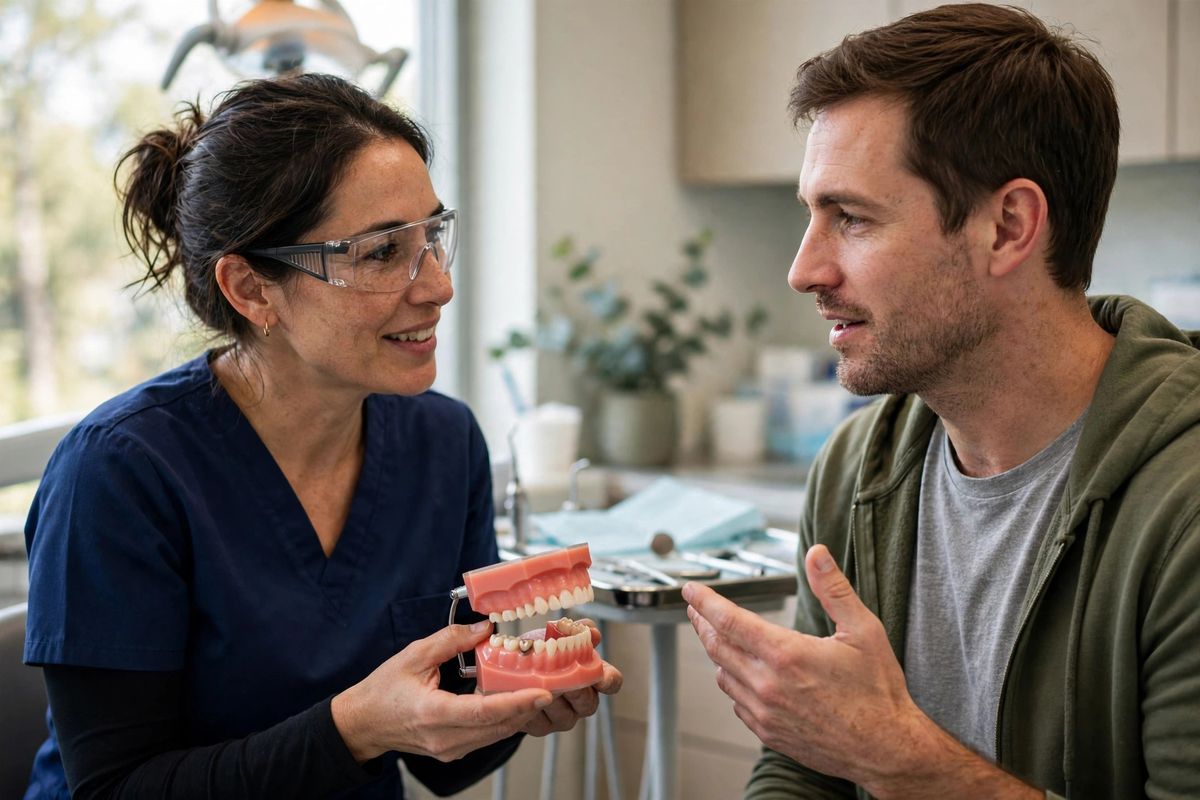
Dental bridge vs implant: the honest comparison
Effect on neighbouring teeth. A bridge requires shaping the teeth beside the gap for crowns. An implant leaves them alone.
Timeline. A bridge is typically finished in weeks. An implant takes months, because the bone-bonding stage cannot be rushed.
Bone. An implant helps preserve jawbone at the site. A bridge does not stimulate the bone under the gap, so some shrinkage over time is expected there.
Maintenance. A bridge needs cleaning underneath the artificial tooth with floss threaders or interdental brushes. An implant crown is cleaned much like a natural tooth, but still needs regular professional checks.
Longevity. Both can serve for many years; neither comes with a guarantee. Bridges may eventually need replacement if a supporting tooth develops decay or the unit loosens. Implants avoid involving other teeth, but they can fail — particularly with smoking, gum disease or poor maintenance.
When a bridge is usually the better fit
A bridge is often the sensible choice when the teeth beside the gap already need crowns — the bridge restores them and fills the gap in one plan — when the timeline matters and months of implant healing are impractical, when bone at the site is insufficient and grafting is not desired, or when a medical situation makes surgery a poor idea. It is a well-established treatment with decades of use behind it.
When an implant is usually the better fit
An implant is often preferred when the neighbouring teeth are healthy and untouched — patients reasonably hesitate to shape sound teeth for crowns — when the priority is preserving bone, and when the patient is comfortable with the longer, staged timeline and the maintenance it asks for. Candidacy is individual: gum health, bone volume, smoking and some medical conditions can change the recommendation, which is why the assessment comes before any decision. At Smile Avenue, digital planning with our iTero scanner helps map the case before treatment begins.
What about a Maryland bridge, or a denture for one tooth?
A Maryland bridge holds an artificial tooth with small bonded wings behind the neighbouring teeth, without full crowns — a conservative option in the right case, most often for a front tooth. Our guide to Maryland bridges explains where they work well and where they do not. A removable partial denture for a single tooth is also possible — usually the simplest option, and sometimes the right interim step while a longer plan is decided.
Coverage notes, stated plainly
Patients often ask what programs cover. The honest summary: dental implants are not part of standard Canadian Dental Care Plan coverage, and fixed dental bridges are not covered by the CDCP either. Crowns may be covered for eligible CDCP patients, subject to preauthorization, and dentures are a covered category for eligible patients. Smile Avenue accepts many major insurance plans; what your own plan covers varies, and you will receive a written estimate for each option before treatment so the comparison includes your real share — we do not publish prices, because the right figure depends on your case.
To talk through both options for your own gap, call Smile Avenue Dentistry at (416) 250-5354. We are open Monday to Friday and Sundays, 9 a.m. to 7 p.m., and closed Saturdays.
Frequently asked questions
Which option lasts longer, a bridge or an implant?
Both can last many years with good care. Implants often have the longer track record at a single-tooth site because they do not depend on neighbouring teeth, but bridges remain a durable, proven option. Neither can be guaranteed — maintenance, bite forces and gum health decide more than the choice itself.
Can I start with a bridge and get an implant later?
Sometimes, yes — patients do move from a bridge to an implant later. Be aware that bone under a bridge gap gradually shrinks, so a later implant may need grafting first. If you think you will want an implant eventually, it is worth discussing that at the start.
Does either option damage the teeth beside the gap?
A traditional bridge requires reshaping the neighbouring teeth for crowns, which is a permanent change to those teeth. An implant does not involve the neighbouring teeth at all. A Maryland bridge is the middle ground — it bonds to the backs of the neighbours with minimal alteration, in suitable cases.
How many visits does each option take?
A bridge is usually completed over a few appointments across several weeks. An implant is staged over months: assessment, placement, a healing period while the bone bonds to the implant, then the final crown. Your dentist will map the appointments for your case at the assessment.
Is one option better for front teeth than back teeth?
It depends on the gap and its neighbours. Front teeth carry lighter biting forces, which is why conservative options like Maryland bridges are considered there more often. Back teeth carry heavy chewing loads, which shapes both bridge design and implant planning. The assessment weighs your specific site.
Does the CDCP cover a bridge or an implant?
No to both, in standard coverage: fixed dental bridges are not covered by the CDCP, and dental implants are not covered either. Crowns may be covered for eligible patients with preauthorization. Eligibility is assessed first, and we will explain your options plainly before any treatment.
What if I’m not ready to decide?
That is common, and a short delay to decide is usually fine — but a gap should not be left indefinitely without a plan. Teeth beside and opposite a gap can drift, and bone at the site shrinks over time. An assessment now gives you both options in writing, even if you proceed later.
Will a bridge or implant look natural?
Both are made to match the shape and shade of your surrounding teeth, and both are custom-made for your mouth. A well-made bridge or implant crown is designed to blend in — though no restoration is literally identical to a natural tooth, and your dentist will show you what to expect.
References
- Ontario Dental Association — patient information on bridges, crowns and tooth replacement.
- Canadian Dental Association — patient resources on dental implants and restorative care.
- Royal College of Dental Surgeons of Ontario — verify any Ontario dentist’s registration on the public register.
- Canada.ca — Canadian Dental Care Plan — official eligibility and coverage information, including services that require preauthorization.