The choice between full vs partial dentures in North York starts with one question: how many healthy teeth do you still have, and can they be kept? A partial denture works around remaining teeth; a full denture replaces a complete arch when no teeth remain — or when the remaining teeth can no longer be saved. This guide compares both honestly, including who each one does not suit.
For the full picture of both appliances, see our page on dentures in North York at Smile Avenue Dentistry, then come back to the comparison.
On this page
The short answer
If you have several sound natural teeth, a partial denture usually keeps them working for you — they help support and stabilise the appliance, and keeping natural teeth helps preserve bone. If no teeth remain in an arch, or the remaining teeth are too weak or diseased to keep, a full denture is the option for that arch. The decision is made tooth by tooth at an assessment, not in advance.
Full vs partial dentures, side by side
| Full (complete) denture | Partial denture | |
|---|---|---|
| What it is / how it works | A removable appliance replacing every tooth in the upper or lower arch, resting on the gums and held by fit and, for uppers, suction against the palate. | A removable appliance replacing some missing teeth in an arch, supported by the gums and by clasps or attachments on the remaining natural teeth. |
| Typical lifespan | Prosthodontic guidance commonly reports that dentures of both types need relining as the gums and underlying bone change shape, with replacement often discussed after roughly 5–10 years of wear. These are planning ranges from professional guidance, not guarantees — fit changes with your mouth, not the calendar alone. | |
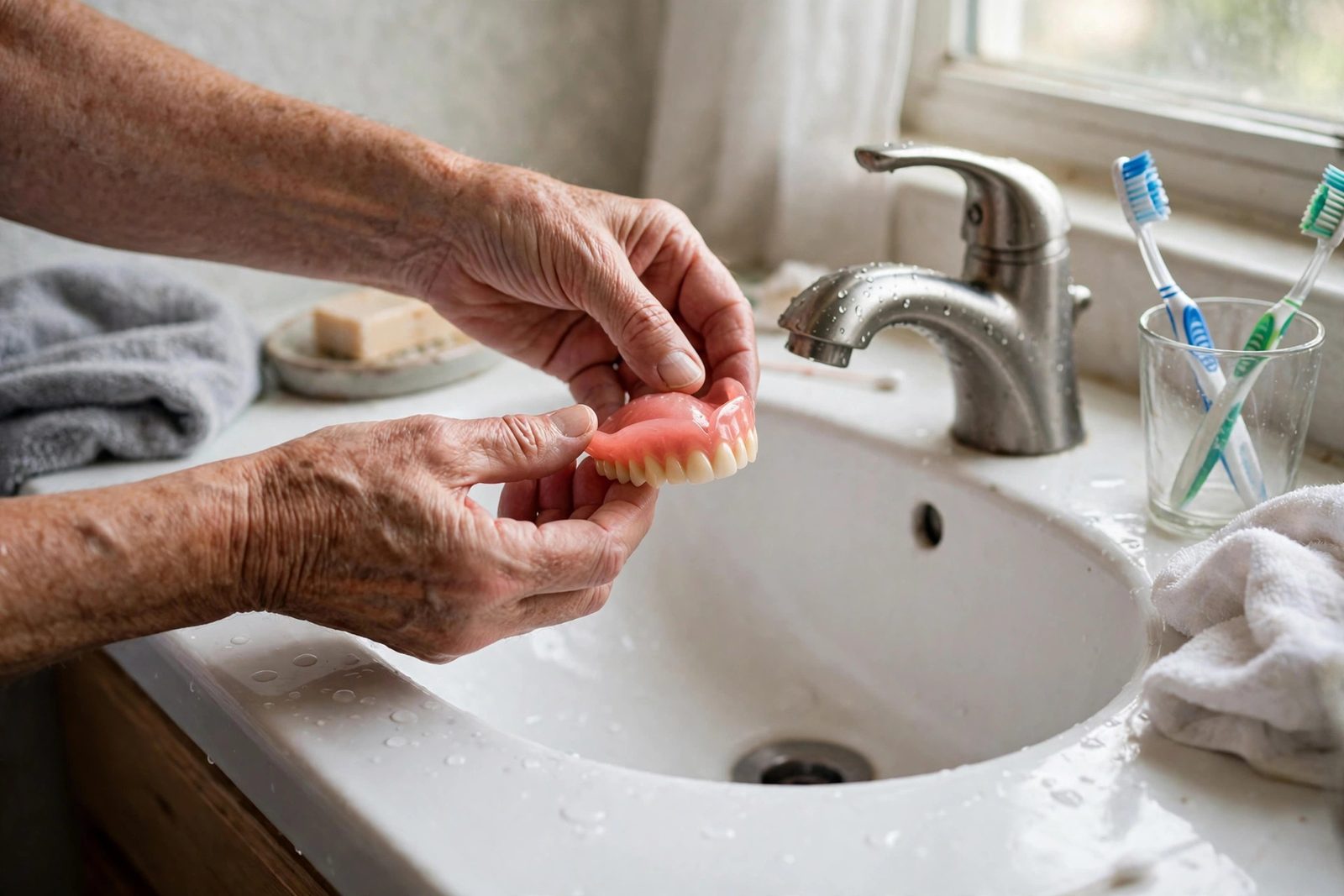
| Maintenance and care | Removed daily for cleaning; soaked overnight; gums rested and cleaned. Adhesive may help some wearers but is not a fix for a loose denture. | Removed daily for cleaning, plus careful brushing and flossing of the natural teeth it clasps — those teeth carry extra load and are at higher decay risk if hygiene slips. |
| Effect on neighbouring teeth and jawbone | No natural teeth remain in the arch to support it. Without tooth roots, the jawbone in that arch gradually resorbs over time, which is why fit loosens. | Remaining teeth help preserve bone around their roots and stabilise the appliance, but clasped teeth take extra forces and need monitoring at check-ups. |
| Who it suits and who it does not | Suits patients missing all teeth in an arch, or whose remaining teeth cannot be saved. Lower full dentures are harder for many people because there is no palate for suction — expectations need to be set honestly. | Suits patients with several healthy remaining teeth and gaps to fill. May not suit patients whose remaining teeth are loose, heavily decayed, or too few and poorly positioned to support an appliance. |
| Number of visits and timeline | Several visits over a few weeks: impressions, bite records, a try-in, then fitting and follow-up adjustments. If teeth are extracted first, healing time or an immediate denture plan is discussed. | Several visits over a few weeks, similar in pattern; any treatment the supporting teeth need (fillings, hygiene) comes first. |
| CDCP coverage | Dentures are a service the Canadian Dental Care Plan can cover for eligible patients, subject to the plan’s rules and preauthorization — eligibility always comes first, and coverage is never assumed. Smile Avenue Dentistry accepts many major insurance plans; ask us to check yours. Federal details: Canada.ca — Canadian Dental Care Plan. | |
How to choose
The honest starting point is the condition of your remaining teeth: teeth that are sound are usually worth keeping, and they make any appliance work better. Next come comfort expectations — a partial denture anchored by teeth generally feels more stable than a lower full denture. Finally, think about maintenance: a partial denture asks more of your daily hygiene because natural teeth remain. Factors that affect cost include the number of teeth replaced, the denture material and framework, and any treatment the remaining teeth need first, so an exact figure follows an assessment. Call Smile Avenue Dentistry in North York at (416) 250-5354. The clinic is open Sunday and closed Saturday.
Common questions
Can I start with a partial and move to a full denture later?
Yes — this is a common path. If a supporting tooth is later lost, the partial can sometimes be modified, or a full denture made when the arch requires it. Planning for that possibility happens at your assessment.
Will a full denture feel like my own teeth?
No, and it is better to know that in advance. Dentures rest on gum tissue, chewing force is lower than with natural teeth, and there is an adjustment period for speech and eating. Most wearers adapt well with follow-up adjustments.
Why does my denture loosen over time?
After teeth are lost, the jawbone slowly changes shape, so a denture that fit well at first gradually loosens. Relining or remaking the denture addresses this; adhesive is only a short-term aid.
Do partial dentures damage the teeth they clasp?
They place extra load on those teeth, and plaque collects around clasps. With good daily cleaning and regular check-ups the risk is managed; without them, clasped teeth are more prone to decay.
How long does it take to get used to a new denture?
Most people need a few weeks of practice with eating softer foods and reading aloud. Sore spots are common early on and are adjusted at follow-up visits.
Can I sleep in my dentures?
It is generally recommended to remove dentures overnight so the gums rest, and to store the denture in water or a cleaning solution as directed.
What if only my lower teeth are missing?
Then only the lower arch needs an appliance — full and partial choices are made per arch, not for the whole mouth at once.
Does the CDCP cover dentures?
Dentures can be covered for eligible CDCP patients, subject to plan rules and preauthorization. Eligibility comes first — call (416) 250-5354 and we can help you check your situation and your insurance, including many major insurance plans.
Smile Avenue Dentistry, North York — (416) 250-5354. Open Sunday, closed Saturday.