

Dental Implants vs Dentures in North York: Fixed Roots or a Removable Smile?
Comparing dental implants vs dentures in North York starts with one plain difference: implants are fixed in the jaw, dentures come out at night. Everything else — chewing confidence, bone changes, daily care — flows from that. This guide from Smile Avenue Dentistry compares the two honestly, including the implant-supported option that sits between them. Read more about the fixed option on our dental implants in North York page and the removable option on our dentures in North York page.
What each option is
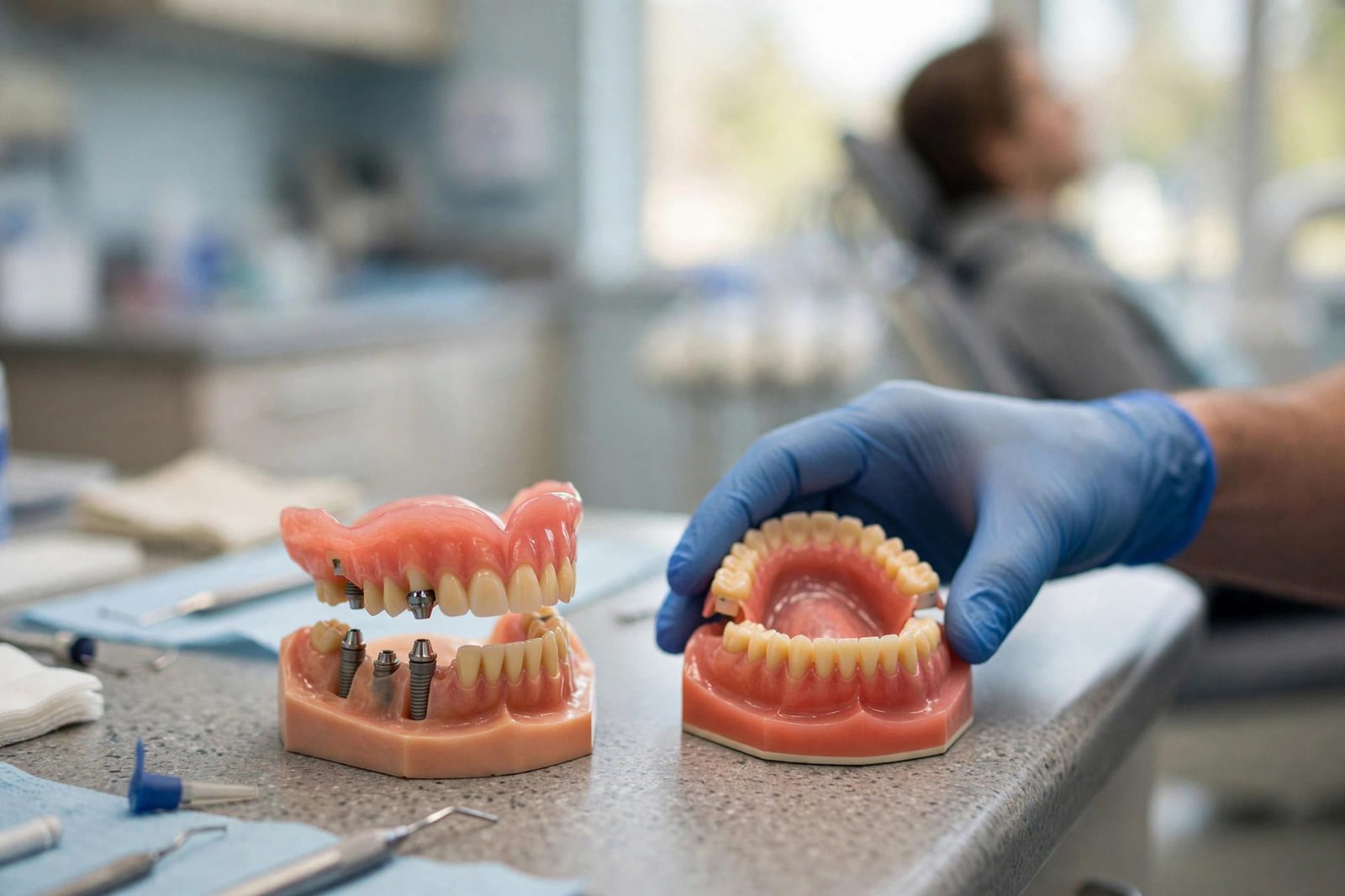
A denture is a removable plate of artificial teeth that rests on the gums. A full denture replaces a whole arch; a partial denture fills several gaps and clips to remaining teeth. A dental implant is a titanium post placed in the jawbone that acts as an artificial root — it can carry a single crown, support a bridge, or anchor a denture so it clicks firmly into place. That third use matters: “implants vs dentures” is not always either-or, because a denture held by implants behaves very differently from a denture held by suction and adhesive alone.
Side-by-side comparison: implants vs dentures
| Question | Dental implants | Dentures (removable) |
|---|---|---|
| What it is / how it works | Titanium posts in the jawbone act as roots. They carry crowns or bridges, or anchor a denture so it locks in place instead of resting on the gums. | A removable acrylic plate of artificial teeth resting on the gums, held by fit, suction and sometimes adhesive; taken out nightly for cleaning. |
| Typical lifespan | Systematic reviews by Pjetursson and colleagues report roughly 9 in 10 single implants still in place and functioning at 10 years. A denture attached to implants still needs its acrylic and teeth maintained or remade over time, like any denture. | Dentures do not have a fixed lifespan figure in the literature; the Canadian Dental Association notes they typically need relining or replacement over the years because the jaw underneath them keeps changing shape. Fit, not the calendar alone, decides when. |
| Maintenance and care | Brush and clean around implants daily like natural teeth; an implant-supported denture is removed for cleaning while the implants themselves are brushed in the mouth. | Remove and brush daily, soak as directed, and clean the gums and any remaining teeth. Adhesive is not a substitute for fit — a denture that suddenly needs much more adhesive needs an appointment. |
| Effect on neighbouring teeth and jawbone | Implants load the jawbone where roots were lost, which helps preserve bone there. A bone-supported bite also takes pressure off the gums. | Without roots or implants, the jawbone under a denture gradually shrinks, which is why dentures loosen over the years. A partial denture’s clasps put extra load on the teeth they grip. |
| Who it suits and who it does not | Suits patients with adequate bone and health who want fixed teeth or a firmly anchored denture. It may not suit uncontrolled medical conditions, very low bone without grafting, or patients who cannot manage the surgical healing period. | Suits patients who need many teeth replaced without surgery, or as an interim step. It does not suit patients who cannot tolerate a removable appliance, struggle with gagging, or whose lower jaw ridge is already very flat — those are often the patients who benefit most from implant anchoring. |
| Number of visits and timeline | Several visits over a few months: placement, healing while bone bonds to the posts, then the teeth are made and fitted. | Usually a series of visits over a few weeks for impressions, try-ins and fitting — no surgery and no months of healing before you have teeth. |
| CDCP coverage | Dental implants are not covered by the Canadian Dental Care Plan. | Complete and partial dentures may be covered under the CDCP for eligible patients, subject to plan rules. Eligibility comes first, and coverage is never 100% of every fee. |
How to choose
Count the teeth and test the tolerance. Replacing one or two teeth rarely points to a denture; replacing a full arch opens all three doors — conventional denture, implant-anchored denture, or fixed implant teeth — in that order of involvement. Then be honest about removability: some patients are perfectly content taking teeth out at night; others know they never will be. Health, bone and budget for maintenance all count too. Smile Avenue accepts many major insurance plans (not every plan), and we will check yours before treatment. Our hours include Sundays and we are closed Saturdays — a full denture problem on a Sunday is something we can usually see about, so call (416) 250-5354.
Factors that affect cost
We do not publish prices, because the figure depends on how many implants, whether grafting is needed, the type of denture, and the materials chosen. What we can promise is process: an examination first, then an exact written quote before anything begins. Call Smile Avenue Dentistry in North York at (416) 250-5354 to book an assessment.
Frequently asked questions
Are implants always better than dentures?
No. Implants offer fixed, bone-supporting teeth, but they need surgery, healing time and adequate bone and health. A well-made denture remains the right answer for many patients — especially when many teeth are missing and surgery is not advisable. The honest answer depends on your mouth, not on a ranking.
What is an implant-supported denture?
It is a denture that clicks onto a small number of implants — often two in the lower jaw — instead of resting on the gums alone. It still comes out for cleaning, but it stays put while eating and speaking far better than a conventional lower denture.
Why does my denture keep getting loose?
Because the jawbone under it shrinks slowly once tooth roots are gone — that is normal biology, not a badly made denture. A reline refits the surface for a while; when the ridge is very flat, implant anchoring is often the lasting fix.
Can I go straight from extractions to dentures?
Yes — an immediate denture is made before the extractions and fitted the same day, so you never go without teeth. It will need relines as the gums heal and shrink over the following months. Some patients later convert to implant support once healing is complete.
Do implants hurt?
Placement is done with local anaesthesia (freezing), and most patients manage the following days with ordinary pain relief. We will not promise a pain-free experience — a few sore days are normal — but the procedure itself is numb, and you will know exactly what to expect beforehand.
Are dentures or implants covered by the CDCP?
Dentures may be covered for eligible CDCP patients under plan rules; implants are not covered at all. Eligibility comes first and coverage is never 100% of every fee. Bring your CDCP details and we will walk through what applies to you.
How do I clean an implant-supported denture?
Remove the denture and brush it like a regular denture. Brush the implant attachments in your mouth with a soft brush, and clean around each implant at the gumline. We will show you the routine at fitting and check your technique at recall visits.
Am I too old for implants?
Age alone rarely decides it. Bone, gum health, medical conditions and medications matter far more, and many patients in their seventies and eighties anchor dentures with implants successfully. The assessment — not your age — gives the answer.
Sources and further reading
- Canadian Dental Association (CDA) — patient guidance on dental treatments.
- Ontario Dental Association (ODA) — patient resources for Ontario.
- Canadian Dental Care Plan — Canada.ca — official coverage information.